ABC local radio (FM 97.7) is the official source of current fire information and warnings.
Phone
The Victorian Bushfire Information Line is a free call on 1800 240 667; you can speak to an operator who can give an up to date report on any serious fire
CFA Region 22
The Strathbogie Tableland is in CFA Region 22, which has its headquarters in Shepparton. The office can be contacted about any fire-related matters, including burning-off restrictions and weather warnings, on 5833 2400.
Neighbourhood groups working together to prepare for the bushfire season.
There are three Rural Fire Brigades on the Strathbogie Tableland – Strathbogie, Marraweeny and Kelvin View.
Each is manned entirely by volunteers from the local community, supported by the Victorian Country Fire Authority. Between them, they have four tankers and a total of well over 100 members.
Recent reforms within the CFA now require active members to have completed a Minimum Skills Training Course which gives volunteers a basic understanding of wildfire, the conditions under which it occurs and modern techniques for managing it. All three brigades have a proud history of turning out to fight bushfires and structural fires, both locally and as far afield as interstate, and many members have given years of such service including hundreds of hours over the four months of the 2025/2026 fire season.
The Strathbogie Tableland is an area of the state which is vulnerable to fire and the community depends almost entirely on these local volunteers to be the first response to any fire emergency. Their work is deeply appreciated by residents.
Frequently asked questions
What happens when I report a fire or smoke?
Your 000 call (note: triple zero, not triple ”oh”) goes straight to FireCom at its Ballarat call centre. You will be asked to explain what you’ve seen and to give as accurate a description as possible of the location of the smoke or fire. (The simplest way of giving a location is to use the new Rural Road number, which every property now has.)
Tankers and crews from up to three nearest brigades, depending on the size of fire, are then called out via pager. Volunteers respond, make up crews, and head off to the scene. An officer is designated as incident controller and, if the local response is sufficient, no more resources will be allocated unless required later.
If the incident is major and escalating, then more crews will be called in from nearby brigades. Further support such as earthmoving equipment to cut containment lines may be requested.
Fixed wing aircraft and helicopters can be called in to drop water and foam, or even fire fighters if the terrain is inaccessible. As a fire is upgraded in severity, more senior CFA staff will become involved, both at the fireground and at regional centres, and incident control responsibility moves up the chain of command. All of this adds up to major strategic planning, involving co-ordination of other bodies such as DES, the police, SES, the ABC, print media and local government, and there is a massive organisational structure in place to achieve this.
The bottom line, though, is that the basic workforce in fighting bushfires is still the local volunteers with their tankers, doing the gritty work on the ground to contain fires and minimize their damage. There are over 60,000 CFA volunteers in Victoria of all ages and from all walks of life.
Who can join the CFA?
Any landholder or resident is eligible to join one of the Tableland Rural Fire Brigades after undertaking CFA minimum skills training. This is a pre-requisite to becoming part of the active firefighting force. Active members are expected to make a commitment both to training and to turning out to a fire when needed. All volunteers are welcome and should contact the appropriate local captain or other officer in their district (see below). Our memberships span a good age range and include both women and men volunteers. Young people over 16 can become full members. Each brigade has a roster for Sunday truck runs, and active members are rostered on for training every few weeks.
Members prepared to making an ongoing commitment to serve can be selected for further training in a variety of skills; advanced 4WD driving techniques, heavy vehicle driver training, first aid, low structure firefighting techniques and crew leadership are some examples. Strathbogie has a Junior Fire Brigade.
Who should I contact?
Strathbogie CFA
Captain
Dana Last
0407 689 608
First Lieutenant
Sim Ayres
0455 246 141
Second Lieutenant
Tanya Lumley
0434 494 669
Third Lieutenant
David Hamilton
0427 051 446
Fourth Lieutenant
Chopper Hopper
0420 500 621
Secretary/Treasurer
David Hamilton
0427 051 446
Communications Officer
Lorraine Millar
0427 905 317
Marraweeny CFA
Captain
Rob Hopkins
0417 147 725
First Lieutenant
Stewart MacLaughlin
0457 652 105
Second Lieutenant
Will Rigby-Jones
0412 077 470
Third Lieutenant
Alan Simpson
0429 864 166
Secretary/Treasurer
Bev Hopkins
0417 147 793
Communications Officer
Margaret Mactier
0458 328 873
Kelvin View CFA
Captain
Anthony Delahey
0458 767 583
First Lieutenant
Gavin Crosbie
0428 952 882
Second Lieutenant
Dean Burton
0419 453 161
Third Lieutenant
Russell Hobbs
0439 908 593
Secretary/Treasurer
Christine Chittick
0417 359 723
Communications Officer
Cherie Halfpenny-
Stannard
0425 376 624
How are the brigades equipped?
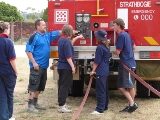
The basic CFA firefighting unit is a 4WD truck with a large water tank and pump. These vehicles are designed primarily for off-road rural and forest work, places where there are no mains water supplies or other reliable water source, and can carry up to five crew.
The three tableland brigades have between them five firefighting tankers, including the Strathbogie RFB vehicle, one of the latest generation of CFA trucks which incorporate some major design innovations, particularly relating to crew safety.
Apart from their hoses and water tanks, ranging from 650 to 3750 litres capacity, all vehicles carry ancillary equipment such as chain saws, rake hoes and foam tanks as well as other safety and recovery gear. Newer tankers carry a reserve of 750 litres to be used for crew protection if the tanker is caught by fire. The truck-mounted pumps can deliver large quantities of water and foam rapidly, and use suction to replenish their tanks from dams or other water sources. A range of hoses and specialist nozzles are carried on board.
Radio communications are a vital part of modern firefighting, allowing incident controllers to co-ordinate teams and vehicles to maximum advantage. Vehicle-mounted and handheld radios are essential tools these days.
How can I be more self-reliant in protecting my own property?
Each year, there are CFA-sponsored workshops conducted for landholders and residents on the tableland at which a trainer gives a detailed presentation on this topic. It includes the importance of developing a personal fire plan, measures to reduce fire hazards, how to behave if fire threatens and so on. These have proved to be very helpful sessions.
In addition, a number of informal “FireGuard” groups, sponsored by CFA, are being established to assist people to develop local neighbourhood responses (such as a phone tree or UHF radio network and other procedures) to help each other. Details are well publicised in October/November each year.
For help in reviewing or developing your personal fire plan, contact any of the officers above in your district. There are also very helpful publications available. Ask for them.
100 years of firefighting
Firefighting today has come a long way since the early days of hand operated pumps and horse-drawn water carts. As the last few years have shown, wildfire can still be a dangerous adversary but the level of training of volunteers, the quality of equipment that we now have and the overall sophistication of the two major organisations – CFA and DEECA– have achieved a revolution in our ability to deal with bushfires.